

In 2026, the way developers work with AI has fundamentally changed. The era of typing a prompt, reading a response, correcting the model, and re-prompting is ending. A new discipline has emerged from the developer community that treats AI agents not as chat partners but as autonomous systems driven by control loops. That discipline is loop engineering.
Loop engineering is the practice of writing outer control loops that drive AI agents autonomously. Instead of manually prompt-correct-reprompting through every step, a loop engineer writes code that prompts the agent, evaluates the output, decides what to do next, and iterates until a goal is met or a safety limit is hit. The developer's job shifts from babysitting a chat window to designing, governing, and verifying the loops that run the agents.
This shift matters because the babysitter bottleneck is real. Manually steering an agent through every turn is slow, error-prone, and, as one prominent engineer described it, "the most boring job in the world." Loop engineering eliminates that bottleneck by codifying the steering logic into repeatable, auditable, production-grade software.
In this article, we cover everything you need to know about loop engineering: where it came from, how it works, the maturity model that tracks its evolution, the core patterns practitioners use, the safety controls that make it viable in production, and how enterprises are adopting it under governance.
The defining statement of loop engineering came from Boris Cherny, Head of Claude Code at Anthropic:
"I don't prompt Claude anymore. I write loops that prompt Claude and figure out what to do."
This single quote captures the paradigm shift. The most skilled AI engineers are no longer optimizing prompts. They are building systems around agents. Andrej Karpathy has reinforced this idea, noting that large language models become dramatically better when forced into disciplined workflows rather than free-form conversation.
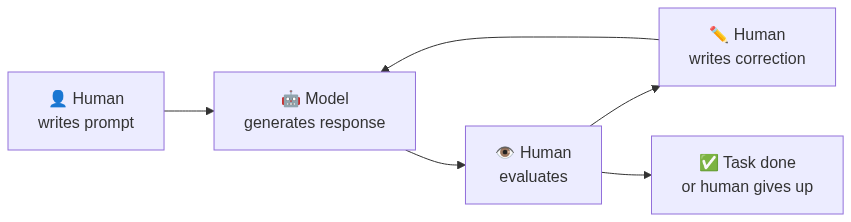
The manual prompting workflow looks like this:
Every step requires human attention. The human is the loop. This works for quick tasks but breaks down when you need an agent to verify hundreds of user flows, fix production errors flagged by monitoring tools, or iterate on a complex codebase over hours.
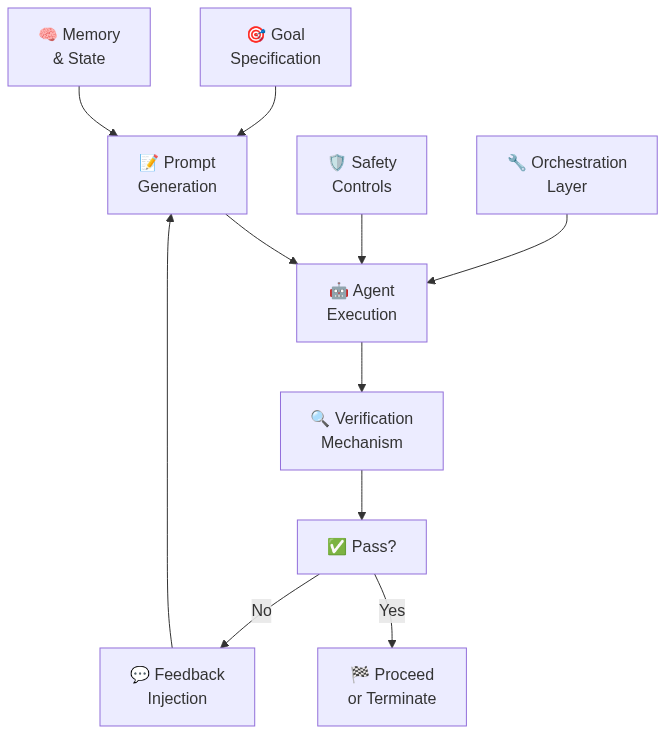
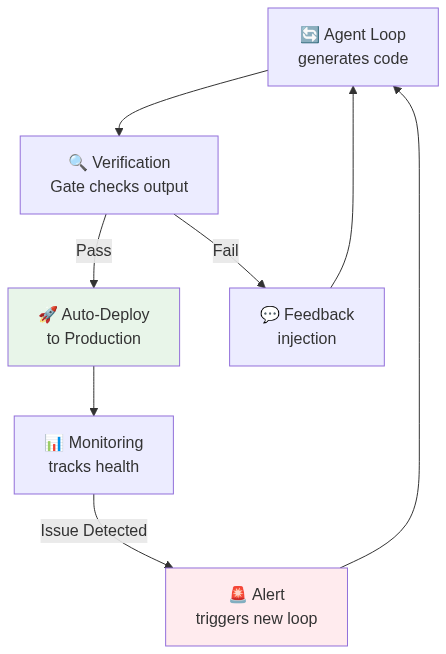
The loop-driven workflow replaces the human loop with a software loop:
The human's role changes from turn-by-turn operator to loop designer and supervisor. This is a fundamentally different job, and it is the job that loop engineering prepares you for.
Loop engineering is the discipline of designing, building, and operating autonomous control loops that drive AI agents to completion. It borrows its name and core philosophy from control systems engineering, where feedback loops regulate physical and software processes. In the AI context, the loop regulates the agent's behavior through prompts, evaluations, memory, and safety constraints.
A loop-engineered system has several core components:
Loop engineering is not the same as prompt engineering. Prompt engineering optimizes what you say to a model in a single turn. Loop engineering optimizes the system that decides what to say, when to say it, and what to do with the response across many turns. Prompt engineering is a skill within loop engineering, but loop engineering is the broader discipline.
The Anthropic agent guide describes this distinction well: effective agents are built from composable patterns, not single prompts. The guide outlines patterns like routing, tool use, and evaluation loops that are foundational to loop engineering practice.
Not all loops are created equal. The developer community has begun organizing loop sophistication into a maturity model spanning six levels beyond manual prompting. This model helps teams assess where they are and where they need to go.
| Level | Name | Description | Human Involvement |
|---|---|---|---|
| L0 | Manual prompting | Human writes each prompt by hand | Full |
| L1 | Templated prompting | Reusable prompt templates with variable substitution | High |
| L2 | Scripted loops | Deterministic scripts call LLMs in a fixed sequence | Medium |
| L3 | Stateful loops | Loops maintain persistent memory and context across iterations | Low |
| L4 | Self-verifying loops | Built-in verification gates check outputs before proceeding | Low |
| L5 | Autonomous goal-seeking loops | Loops decompose goals and self-direct execution | Minimal |
| L6 | Fully autonomous multi-agent loops | Swarms of agents coordinate autonomously toward complex goals | Supervisory only |

Most organizations in 2026 sit between L1 and L3. They have templated prompts and some scripted workflows, but they lack stateful memory and verification gates. The jump from L3 to L4 is where production-grade loop engineering begins, because verification gates are what make autonomous loops safe enough to run without constant supervision.
Key observations about the maturity model:
Loop engineering has developed a set of recurring patterns that practitioners apply across use cases. These patterns are the building blocks of production agent loops.
The maker-checker pattern splits execution and evaluation between models. A faster, less expensive model generates candidate output. A more capable model verifies that output against criteria. This separation improves quality and controls cost.
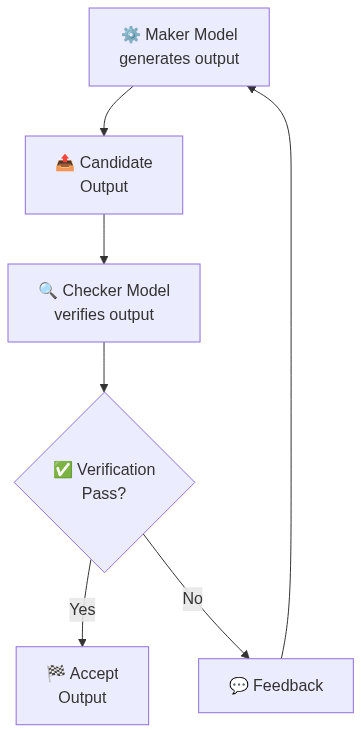
The maker-checker pattern is valuable because:
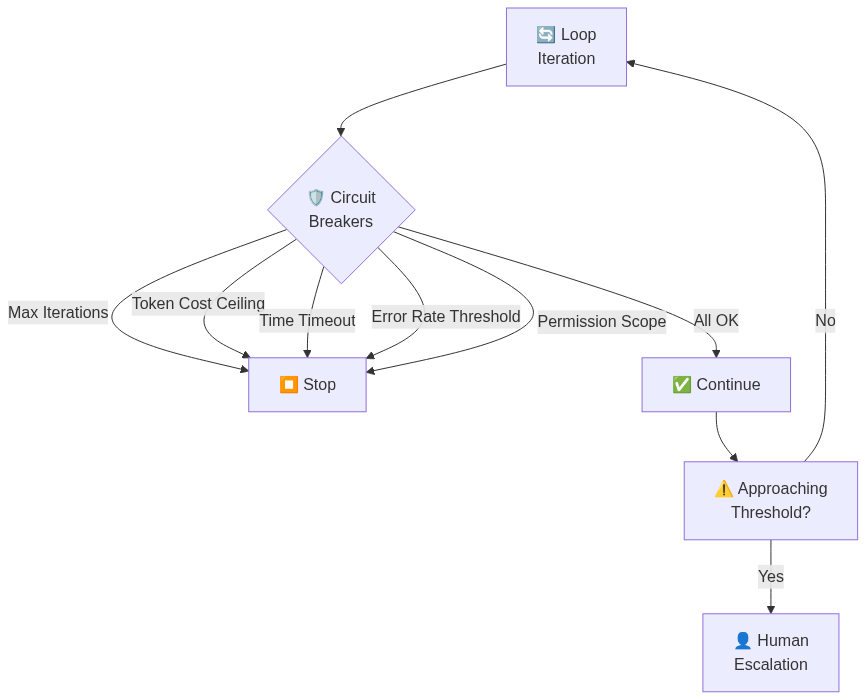
Every production loop must have hard limits. These are not optional. A loop without circuit breakers is an accident waiting to happen. The essential circuit breakers are:
Cross-session memory injection compresses and injects historical context so the agent carries forward what it learned across sessions. Without it, every loop starts from scratch and repeats mistakes. With it, the loop accumulates knowledge and improves over time.
Effective memory injection involves:
Addy Osmani's work on context engineering is directly relevant here. Context engineering is about delivering the right information at the right time to the model. Loop engineering depends on it, because a loop that injects the wrong context will iterate toward the wrong goal.
Loop engineering at L3 and above requires a stateful runtime. This is the infrastructure that keeps a loop running across iterations, sessions, and even restarts. The stateful runtime stack has several layers.
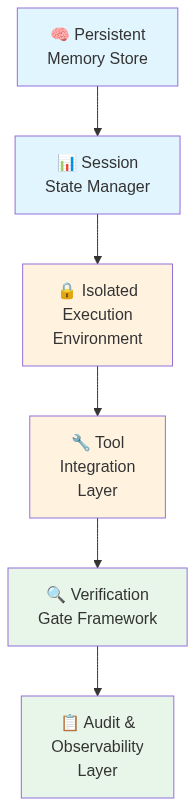
The layers include:
The open-source community is actively building this stack. Projects like Dapr Agents propose standardized stateful execution for long-running agents. The loop-engineering CLI tools repository provides practical utilities for developers building loops. These projects signal that the runtime stack is moving from concept to implementation.
Loop engineering is not just a developer movement. Enterprises are adopting it to solve one of the most persistent pain points in AI-driven development: the deployment velocity gap. AI coding agents can produce candidate code in days, but promoting that code into a governed production runtime traditionally takes weeks. Loop engineering closes that gap by automating the path from generation to deployment within governance boundaries.
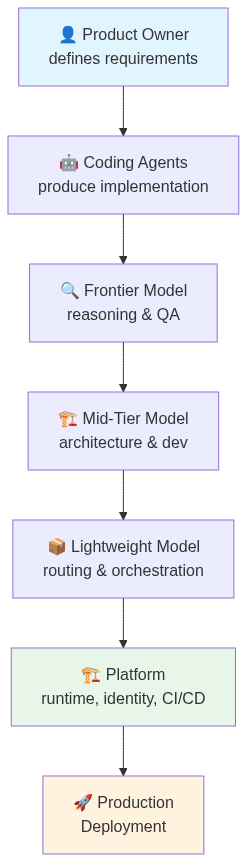
The enterprise loop engineering pipeline includes these stages:
This pipeline turns what was a multi-week manual process into a compressed, auditable workflow. GALLO, the world's largest winery with 70M+ cases produced annually, experienced this transformation firsthand. Their deployment timeline compressed from four weeks to hours, with a 4x increase in delivery velocity. Robert Barrios, CIO of GALLO, described the dynamic:
"When developers ship production-ready code this quickly, how can I have environments spun up fast enough? Shakudo is how we close that gap."
GALLO's approach uses a multi-tier model routing strategy: frontier models handle reasoning and quality assurance, mid-tier models handle architecture and development, and lightweight models handle routing and orchestration. This mirrors the maker-checker pattern at an organizational scale. Barrios also addressed the cost dimension:
"I do not want to be in a position where I have to pay for a token for every single piece of work. Eventually I want to buy compute, scale it, and run our own LLMs next to our data."
This is the economic argument for loop engineering with multi-tier routing: enterprises want compute-based economics, not per-token pricing, when loops run thousands of iterations per day.
Governance is the factor that separates production loop engineering from experimental scripting. Enterprises in regulated industries cannot deploy autonomous agent loops without controls. The governance requirements that shape loop engineering include:
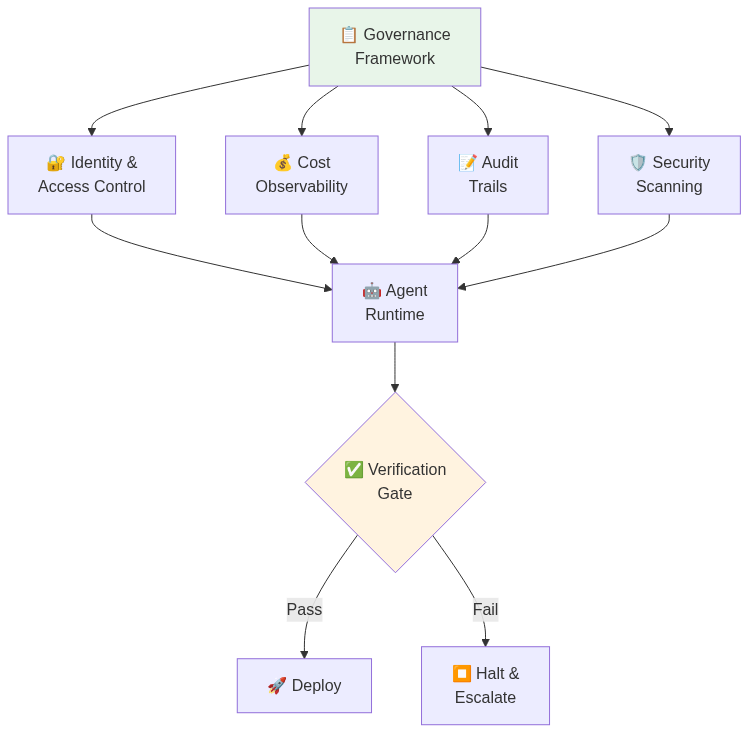
Huntington Bank, a Fortune 500 U.S. bank with $200B+ in assets under management, built their AI platform around these principles. With 100+ AI practitioners, they migrated from a major cloud ML platform to a unified governed AI environment running entirely within their own infrastructure. Their governance framework scored 27 out of 28 control points against ISO 42001 and NIST AI RMF standards. The one gap they identified: agent-level risk ratings and trust-but-verify controls, which are exactly what L4 self-verifying loops provide.
Governance frameworks like ISO 42001 and NIST AI RMF are becoming the baseline for enterprise loop engineering. These frameworks collapse dozens of control points into actionable buckets:
Each bucket maps directly to loop engineering controls. For example, "human oversight" maps to circuit breakers and escalation triggers. "Transparency" maps to audit logging. "Risk management" maps to verification gates and agent risk ratings.
When loops run autonomously, token costs compound quickly. A loop that runs 100 iterations per task across hundreds of tasks per day can generate significant costs if every iteration hits a frontier model. Multi-tier model routing is the solution.
The routing strategy works as follows:
Enterprises report 2x to 20x cost savings with this approach compared to routing all traffic to frontier models. A global asset management firm achieved approximately 3x cost reduction by routing routine agent tasks to mid-tier open-weight models while reserving frontier models for high-reasoning work.
Open-source models play a critical role in this strategy. Enterprises are piloting self-hosted models like Gemma, Nemotron, and Deepseek-class architectures to handle high-volume loop traffic without per-token API costs. The Shakudo platform supports this by providing an AI Gateway that routes requests across proprietary and open-source models with cost tracking, RBAC, and audit trails built in.
FlexiVan, a North American intermodal logistics company managing 120,000+ chassis, moved from experimental AI to operational AI. They use AI vision to replace manual gate recording, eliminating a 2% error rate. Their CIO, Sagar Chikkala, captured the shift:
"AI used to be experimental at FlexiVan. It is no longer experimental. It is operational."
The operationalization Chikkala describes is loop engineering in practice: AI agents running in continuous loops that monitor, detect, classify, and act on real-world events from IoT sensors across their chassis fleet.
Loblaw, Canada's largest retailer with 2,400+ stores and 220,000+ employees, built a centralized governed AI environment. Their approach treats governance as an enabler of scale, not a brake. Every agent loop runs within their secure infrastructure with full data sovereignty. This is the L4 model: autonomous loops with built-in governance gates that allow safe scaling.
Whitecap Resources, the 7th-largest Canadian oil and gas producer at approximately 375,000 boe/d, uses governed AI loops to process TB-scale monthly data and microsecond telemetry. Custom analytics that previously took weeks now complete in under an hour. Their deployment includes cybersecurity scanning of all AI agent skills before they enter production, reflecting the governance-first approach that loop engineering demands in energy and critical infrastructure.
The loop engineering space is forming rapidly. Several platforms are positioning themselves as the runtime for autonomous agent loops:
| Platform | Approach | Enterprise Readiness |
|---|---|---|
| AWS Bedrock AgentCore | Production AI agents with any framework or model | Strong cloud-native; lock-in and cost concerns |
| Google Gemini Enterprise Agent Platform | Build, scale, govern, and optimize agents | Strong model ecosystem; governance maturing |
| Snowflake Cortex Agents | Managed agentic platform within Snowflake | Attractive for Snowflake shops; limited scope |
| OpenAI Codex | Automations with follow-goals and worktrees | Strong code generation; limited enterprise controls |
| Vercel AI SDK (Loop Control) | Loop control primitive for agent orchestration | Developer-friendly; governance not primary focus |
| Dapr Agents | Open-source stateful agent execution | Early-stage; watching for enterprise readiness |
The decision criteria enterprises use, ranked by frequency:
This ranking reveals that the market is governance-first, not model-first. Enterprises are not choosing platforms based on which has the best frontier model. They are choosing based on which lets them run governed loops within their own infrastructure.
If you are a developer or team looking to adopt loop engineering, start with these steps:
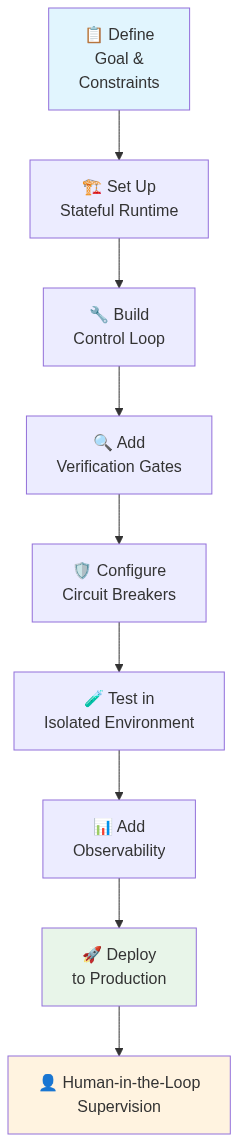
Tools that can help you get started:
Loop engineering is not without risks. The community has an active debate about how much autonomy to give agents, and the concerns are legitimate:
These risks are why governance and circuit breakers are not optional add-ons. They are foundational components of loop engineering. A loop without safety controls is not loop engineering. It is an accident waiting to happen.
Loop engineering is evolving rapidly. Several trends will shape its trajectory through 2026 and beyond:
The Shakudo platform is built for this trajectory. It provides the governed runtime that loop engineering requires: an AI Gateway for multi-tier model routing with cost tracking, Kaji for autonomous agent execution with verification gates, and the infrastructure controls that enterprises need to run agent loops within their own VPC. Whether you are at L2 or moving toward L5, the platform provides the building blocks for production loop engineering.
Loop engineering represents a fundamental shift in how developers work with AI. It moves the discipline from manual prompting to autonomous, governed, verifiable control loops. The maturity model from L0 to L6 provides a roadmap. The core patterns of maker-checker architecture, deterministic circuit breakers, and cross-session memory injection provide the building blocks. And governance frameworks like ISO 42001 and NIST AI RMF provide the safety rails.
Enterprises like GALLO, Huntington Bank, FlexiVan, Loblaw, and Whitecap Resources are already proving that governed loop engineering works at scale. The deployment velocity gap is closing. Token costs are being managed through multi-tier routing. And governance is being built into the loop from day one, not bolted on after.
If your organization is ready to move from manual prompting to governed autonomous loops, talk to Shakudo about deploying loop engineering infrastructure within your own environment.